
Bose-Einstein condensates form when atoms are cooled to temperatures close to absolute zero. A large fraction of the atoms then occupy the same quantum-mechanical state and behave like a single matter wave. Mixtures of two different atomic species open up additional possibilities, as they allow researchers to study both the mutual interactions between the species and their behaviour under the influence of gravity.
Compact quantum gas source for microgravity
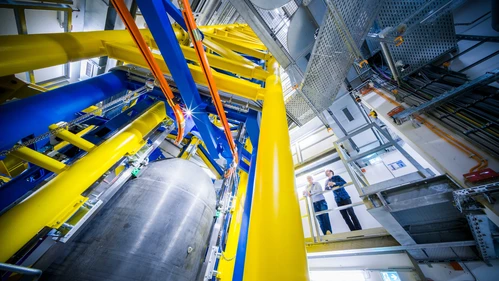
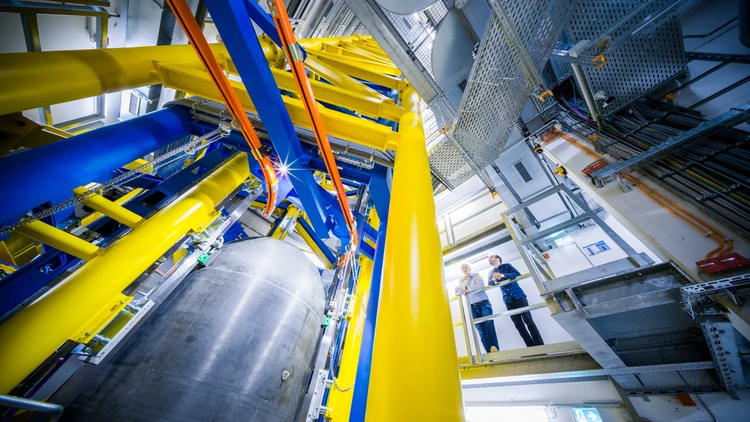
For the experiments, the research team used the fully integrated MAIUS-B apparatus, which was originally developed for use on a sounding rocket. On an atom chip, rubidium atoms are first cooled by microwave evaporative cooling. The potassium atoms are then cooled sympathetically through collisions with the rubidium atoms. In this way, the system can produce a mixture of two Bose-Einstein condensates in just 2.3 seconds – fast enough for the approximately four-second microgravity phase of the Einstein-Elevator.
According to the researchers, the compact source achieves the highest production rate yet reported for such a BEC mixture. Compared with previous mobile and compact experiments, it can provide around an order of magnitude more condensed atoms in the same amount of time. The higher atom numbers also give rise to stronger and therefore more readily measurable interaction effects, allowing the dynamics of the two quantum gases to be investigated in greater detail. The apparatus therefore meets important requirements for future quantum gas experiments on mobile platforms and in space. Many of the methods developed for MAIUS-B and demonstrated in the Einstein-Elevator are also intended for use in BECCAL (Bose-Einstein Condensate and Cold Atom Laboratory), a joint NASA-DLR quantum gas facility for the International Space Station.
Controlled release into free fall
A particular challenge is to release the atoms from their magnetic trap with as little disturbance as possible. The magnetic fields generated by the atom chip and the external coils do not immediately disappear when the atom chip is switched off. As a result, potassium and rubidium can receive momentum kicks of different magnitudes and begin to separate at the onset of free fall.
The team therefore used a tailored switch-off protocol in which the atom chip and magnetic coils are switched off with a precisely chosen delay between them. This greatly reduces the relative velocity of the two atomic species. Measurements in the Einstein-Elevator and at different orientations of the experiment relative to Earth's gravitational field were complemented by three-dimensional numerical simulations.
The images reveal a clear difference between conditions on Earth and in weightlessness: Under the influence of Earth's gravity, the combination of gravity-induced displacement and mutual repulsion spatially separates the two condensates. In microgravity, by contrast, the atomic clouds overlap after their release. Once the remaining magnetic forces are minimised, it is therefore possible to investigate specifically how the interactions between the two quantum gases alone govern their dynamics.
A foundation for future precision experiments
The results lay the foundation for experiments with interacting quantum gases in microgravity. These include studies of novel states of matter such as quantum droplets, the production of ultracold molecules and precision tests of the equivalence principle. Using different atomic species, such tests can determine whether different forms of matter really do fall identically in a gravitational field, which is a central pillar of Einstein's theory of relativity.
The work was carried out within the QUANTUS IV-MAIUS collaboration and was supported in particular by the German Space Agency at DLR and the QuantumFrontiers Cluster of Excellence.
Publication
Piest, B., Böhm, J., Estrampes, T., Guggilam, P. et al. Apparatus for quantum-mixture research in microgravity. Nature Communications 17, 7573 (2026). https://doi.org/10.1038/s41467-026-75968-9