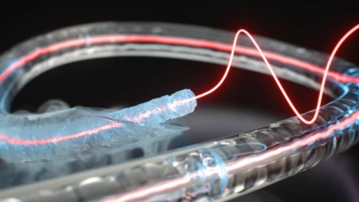
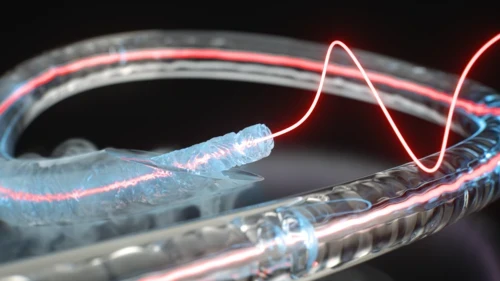
Researchers have developed a new type of optical fibre by freezing a glass capillary filled with liquid. The fibre guides light and sound waves simultaneously and enables the highly efficient coupling of the two wave types. The high coupling strength lowers the energy consumption of photonic neuromorphic computing schemes and quantum signal processing applications by several orders of magnitude.
When a volcano erupts, one can observe the liquid streams of lava cool down and solidify into rock formations at the base of the volcano. The same physical process – a liquid changing into a solid when cooling – can be observed when lakes begin to freeze during a cold winter. These phase changes always come with changes in the physical properties of the material – for example, the density or the refractive index – which govern how sound and light move through it. This fundamental physical process is also used during the melting of glass preforms in order to loosen their structure and form optical fibres from them. These fibres then guide light through their cores, allowing the transmission of information via light over long distances very quickly, which is why they are used widely for telecommunication applications.
For more specialised applications, for example, fibre lasers, fibre endoscopes or fibre sensors, other types of optical fibres have been developed. Hollow-core fibres, for instance, can be filled with different gases or liquids and used to measure temperature distributions, or they can act as microscopic chemistry labs.
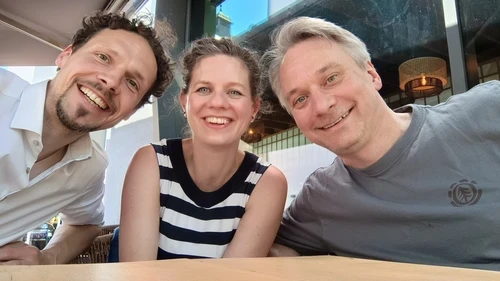
As part of a collaborative project, researchers at the Max Planck Institute for the Science of Light (MPL) in Erlangen, Leibniz University Hannover (LUH) and the Leibniz Institute of Photonic Technology (IPHT) in Jena have developed a new type of optical fibre by freezing liquid-core optical fibres (LiCOF) in nitrogen at -196°C, leading to a phase change in the fibre core from liquid to solid. “The key point is that the frozen section of the LiCOF retains its ability to guide light. Not only that, but both the liquid and the frozen section of the fibre also guide hypersonic sound waves,” says Simon Seiderer, one of the three lead authors of the article and a researcher in the Quantum Optoacoustics research group run by Prof. Dr. Birgit Stiller, who heads the project at MPL and LUH.
The researchers utilise the extremely efficient coupling between light and sound in their new fibre, an effect known as Brillouin-Mandelstam scattering. The effect is already well known in traditional optical fibres; however, with the phase transition to the frozen LiCOF, the researchers have created an extreme, highly confined and dense environment. Here, the optoacoustic coupling becomes more than 1,000 times stronger than in standard optical fibres. By harnessing this efficient coupling, the researchers have demonstrated optoacoustic memory. This fundamental building block for photonic neuromorphic computing in fibres works by utilising the drastic differences in velocities between light and sound waves. Information is transferred from the fast light wave to the much slower sound waves, and later converted back into light. The efficient optoacoustic coupling in the frozen LiCOF opens up new avenues for drastically reducing the energy consumption of photonic computing architectures.
The project was conducted in cooperation with Prof. Markus Schmidt and Prof. Mario Chemnitz from the IPHT Jena, who pioneered the research with liquid-core optical fibres. Through this additional step of freezing the LiCOF’s core, higher nonlinearities have become possible. “By freezing the liquid core, we have created an entirely new physical platform that provides extreme nonlinearities yet is easy to handle,” says Stiller. “While demonstrating a highly efficient optoacoustic memory is a fantastic first step, this level of light-sound coupling opens up exciting new possibilities not only for neuromorphic computing, but also for quantum information processing, microwave photonics and high-precision sensing.”
Original publication in Optica:
Simon Seiderer, Andreas Geilen, Luan N. Sliwa, Linqiao Gan, Xue Qi, Mario Chemnitz, Markus A. Schmidt, and Birgit Stiller, "Giant Brillouin gain in frozen CS2 capillaries,"
Optica 13, 1415-1422 (2026)
DOI: https://doi.org/10.1364/OPTICA.600056
Contact:
Prof. Dr. Birgit Stiller, Max Planck Institute for the Science of Light and Leibniz University Hannover Institute of Photonics, birgit.stiller@iop.uni-hannover.de