


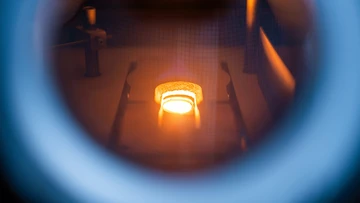


Oxygen plays a dual role in the production of aluminium nitride. On the one hand, annealing – the thermal baking of semiconductor crystals – improves crystal quality. On the other hand, oxygen impurities enter the material during this process. As oxygen donors, these impurities influence the optical and electrical properties of the semiconductor, but are hardly detectable during annealing and are therefore primarily a theoretical component in production. The research team at TU Braunschweig is working to precisely identify the oxygen donors in order to further optimise the manufacturing process.
The researchers used time-resolved cathodoluminescence spectroscopy, in which electron pulses excite the solid to emit electromagnetic radiation. The team identified a specific process in the nanosecond range that exhibited temperature dependence. In the measurements, the oxygen donor ON in aluminium nitride could be clearly distinguished from other material defects and characterised. These results provide fundamental data on the material structure and form a basis for further semiconductor research.
Success factor for basic research and application
This fundamental research from the QuantumFrontiers Cluster of Excellence may influence the diverse fields of application for aluminium nitride-based UV LEDs in the future. UV LEDs are a technological basis for water treatment, surface sterilisation and sensors in gas and biomolecule analysis. The newly created Nitride Technology Centre (NTC) in Braunschweig draws on basic research such as this to bring nitride technologies such as UV LEDs into application in the long term.
Publikation
Szafranski, B., Peters, L., Wolter, S., Margenfeld, C., Waag, A., & Voss, T. (2026). Ionization energy of the oxygen donor in AlN. Applied Physics Letters, 128(4). https://doi.org/10.1063/5.0308036