


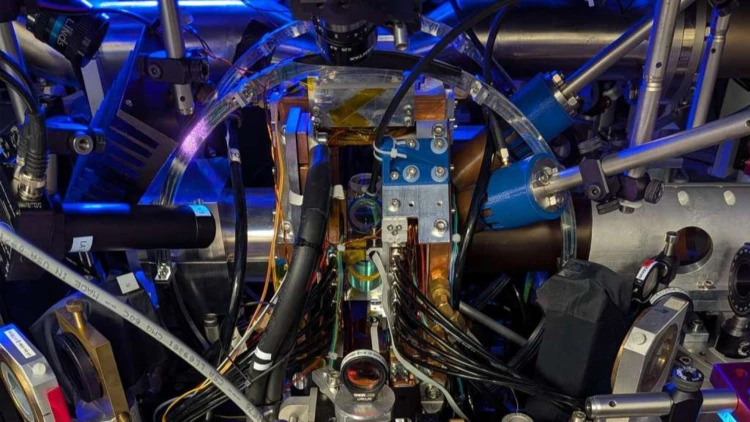
When two bosons interfere at a beam splitter, they always stick together and exit through the same path. Published in 1987 by physicists Chung-Ki Hong, Zhe-Yu Ou, and Leonard Mandel, this "Hong-Ou-Mandel" (HOM) effect is a cornerstone of quantum mechanics. It provides definitive proof that identical quantum particles behave collectively in ways that classical physics cannot explain.
While the two-particle HOM effect is a textbook staple, physicists have long sought to scale this phenomenon to larger numbers of particles. Doing so unlocks highly entangled quantum states that are instrumental for investigating the properties of quantum entanglement and unlocking ultra-precise measurements. However, scaling up has faced a persistent bottleneck.
Traditionally, these experiments rely on photons (particles of light). While photonic systems are excellent for quantum optics, they suffer from unavoidable transmission and detection losses. As the number of photons increases, the probability of losing some of them grows exponentially. This loss blurs the delicate quantum features, making it incredibly difficult to verify true multiparticle interference or to scale the system further.
A recent paper published in Nature Physics circumvents this limitation by swapping light for matter. The collaborative research team, led by QuantumFrontiers researchers at the German Aerospace Center (DLR) and Leibniz University Hannover, successfully demonstrated multiparticle HOM interference using up to 12 indistinguishable neutral atoms, achieving a system with virtually negligible particle loss.
From Photons to Atoms
To achieve this, the researchers shifted away from conventional optical setups. Instead, they utilized spin-changing collisions within a Bose–Einstein condensate – a state of matter where atoms are cooled to near absolute zero and behave as a single quantum entity. This method allowed them to reliably generate "twin-Fock” states, where an exactly equal, known number of identical atoms enter the two paths of a quantum interferometer.
By implementing a specialized detection system capable of counting individual atoms with high fidelity, the team observed the definitive signatures of multiparticle HOM interference. When a large, even number of indistinguishable particles interfere, the output does not simply randomize. Instead, the atoms exhibit "bunching", resulting in a characteristic distribution where only even numbers of atoms are detected in the output paths. The team successfully observed these parity oscillations and the accompanying bunching envelope for up to 12 atoms – a direct extension of the original two-particle experiment that had not been achieved in a lossless, two-mode setting before.
Groundwork for next-generation atom interferometers
The significance of this achievement extends directly into quantum metrology, the science of ultra-precise measurement. By proving that stable, indistinguishable macroscopic states can be controlled and counted at the single-particle level, this experiment bridges the gap between fundamental quantum theory and practical application. It establishes a highly scalable architecture that can be extended to larger atomic ensembles, laying the groundwork for next-generation, high-precision atom interferometers and rigorous multiparticle tests of quantum mechanics.
Publication
Quensen, M., Hetzel, M., Santos, L. et al. Hong–Ou–Mandel interference of more than ten indistinguishable atoms. Nat. Phys. (2026). https://doi.org/10.1038/s41567-026-03302-7