
The vision of the researchers at Leibniz University Hannover is reminiscent of the moment in 1971 when astronaut David Scott dropped a hammer and a feather onto the Moon’s surface at the same time, in order to take advantage of the absence of Earth's conditions for conducting experiments. The key factor back then was the lack of air resistance, which would have slowed the feather’s fall on Earth. Nowadays, it is not hammers and springs that fall, but rather extremely cold atoms in so-called atom interferometers. On the International Space Station, the researchers avoid not only air resistance, but also gravity thanks to the ISS’s endless free fall. Under optimal conditions, the sensitivity of the instruments is squared by the length of the free fall
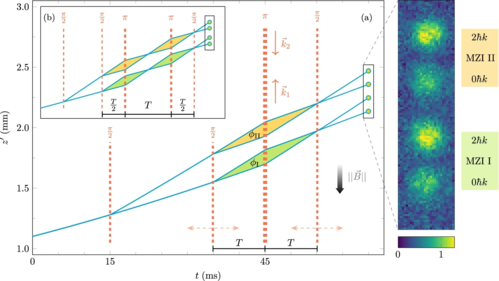
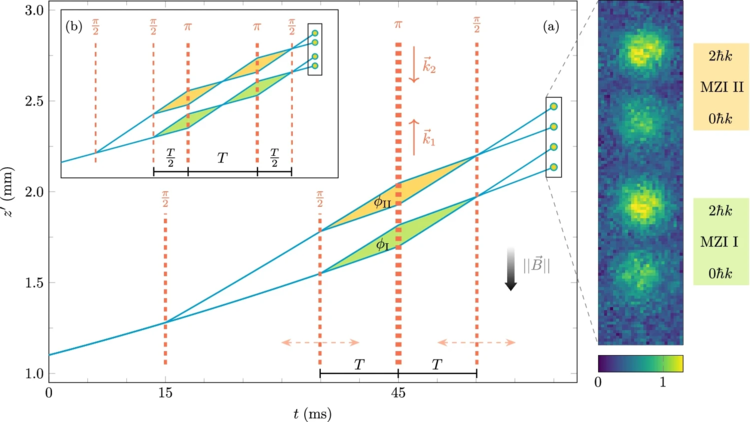
Specifically, the researchers were able, for the first time, to realise a differential atom interferometer using a Bose-Einstein condensate, consisting of two spatially separated Mach-Zehnder interferometers. Following preparatory work and tests on individual aspects of the experiment, successful measurements were carried out for the first time under the weightless conditions of space. Thanks to careful laser calibration and precise control of the atomic source, the interactions between atoms and lasers were observed over 40.3 milliseconds – around ten times longer than in comparable experiments in space. Measurements of the local magnetic field curvature, one of the most significant sources of disturbance for atom interferometry, confirmed the functionality of the experiment
However, the key result is not the measurement data itself, but the success of the overall setup. Building on the experience gained, researchers from the QuantumFrontiers Cluster of Excellence are moving into the next phase and preparing to conduct tests with two different types of atoms in the interferometers. If they succeed here too in increasing the accuracy of the instruments under space-based conditions, the General Theory of Relativity could be tested with unprecedented precision. Similarly, progress in space-based atom interferometry opens up better measurement possibilities for gravity, inertial navigation and magnetic fields.
Publication
Meister, M., Müller, G., Boegel, P. et al. Magnetometry with a space-based differential atom interferometer. Nat Commun 17, 6089 (2026). https://doi.org/10.1038/s41467-026-75230-2
How to dance atom interferometry
Researchers from QuantumFrontiers proved this year at the Dance Your PhD competition that atomic interferometry can even be explained in a truly entertaining way: https://www.youtube.com/watch?v=cy91jjZRy_o